
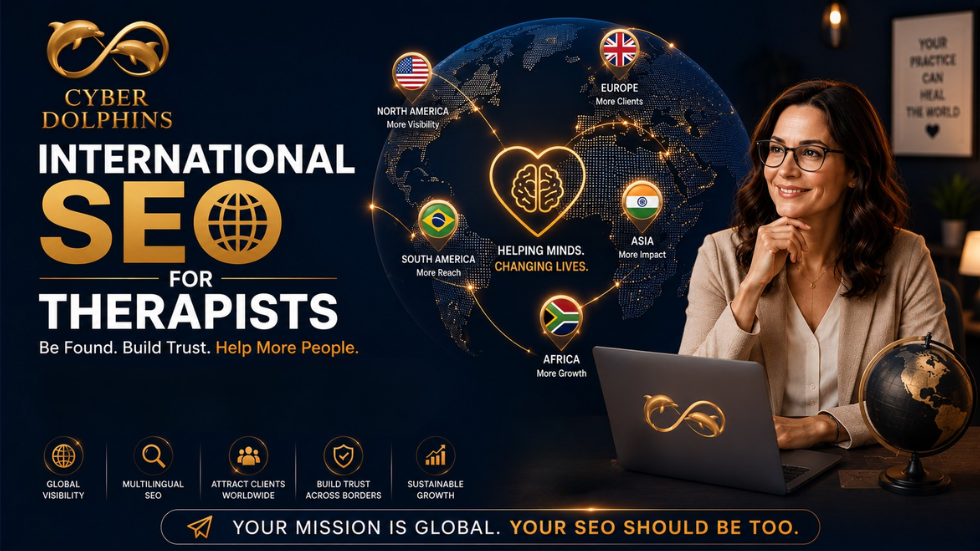
Different regions. Same intent. Different SEO.
Every person searching for a therapist across Europe, Asia, and the West is doing something fundamentally similar. They are reaching a moment of readiness and turning to a search engine to find someone who can help.
The intent is the same. The search engine they use, the language they search in, the format they expect to find, and the trust signals that will convert their click into an enquiry are entirely different by region.
International SEO for therapists is not one strategy applied at scale. It is multiple region-specific strategies unified by a single professional brand. Practices that understand this build sustainable visibility across markets. Those that apply a single approach globally wonder why their excellent content ranks in one region and barely registers in another.
Search Engine Market Share: The Map Most Therapists Never Consult
The foundational assumption behind most international SEO for therapists strategy is that Google is universal. It is not.
Google dominates in Western Europe, North America, Australia, and much of Southeast Asia, holding over 90% search market share in most of these markets. For SEO services for therapists targeting these regions, a Google-centred strategy is appropriate.
But the picture shifts significantly in other markets. In South Korea, Naver holds approximately 55% of the search market share. Korean-speaking mental health clients are more likely to find a therapist through Naver than through Google, and Naver operates on fundamentally different ranking principles. Content that ranks on Google will not automatically rank on Naver. Naver favours content published within its own ecosystem, blog posts on Naver Blog, answers on Naver Knowledge iN, and listings in Naver Place over external websites.
In Japan, Yahoo Japan retains significant market share alongside Google, though the two now share an index. In Russia, Yandex remains dominant, with its own distinct ranking signals and content preferences.
Global private practice SEO that accounts for this regional search engine diversity from the outset builds visibility where clients actually search, not just where Western digital marketing convention assumes they search.
E-E-A-T Signals Across Regional Google Markets
Google’s E-E-A-T framework, Experience, Expertise, Authoritativeness, and Trustworthiness, applies globally. But the specific signals that demonstrate each quality vary meaningfully by region, and international SEO for therapists must account for this variation.
In the United States and Canada, professional association membership, published research, and media mentions in recognised outlets are strong E-E-A-T signals. A therapist featured in Psychology Today or quoted in a major newspaper article builds measurable authority in Google’s assessment of their trustworthiness.
In the United Kingdom, registration with BACP, UKCP, or the BPS functions as a prominent E-E-A-T signal for mental health content. Google’s quality rater guidelines for YMYL (Your Money Your Life) content, a category that explicitly includes mental health, assign significant weight to verifiable professional credentials. A UK-facing therapist website that clearly displays regulatory registration, links to the relevant professional body, and includes verifiable qualifications consistently outperforms one that lists credentials without verification pathways.
In Germany and the Netherlands, academic credentials carry particularly strong E-E-A-T weight. A therapist with a doctoral qualification who publishes content through institutional affiliations, or who is listed on university-affiliated clinical directories, signals a level of authority that influences ranking in these markets beyond what the same content would produce in an Anglo-American context.
SEO services for therapists building global private practice SEO must understand which E-E-A-T signals carry the most weight in each target region and build the practitioner’s digital footprint accordingly, rather than applying a single credential-display template everywhere.
Regional Content Format and Length Preferences
Search engines reflect the content consumption preferences of the populations they serve. International SEO for therapists that ignores regional content format preferences consistently underperforms, even with technically sound optimisation.
In the United States and Australia, long-form content, posts of 1,500 to 2,500 words that comprehensively address a single topic, tends to perform well in health and mental health searches. Google’s quality assessment in these markets rewards depth and comprehensiveness for YMYL topics.
In Japan, content format preferences differ significantly. Shorter, highly structured content with clear visual hierarchy, frequent subheadings, bullet points, and summary sections, performs better than the discursive long-form content that dominates Anglo-American SEO best practice. A worldwide mental health clinics content strategy built entirely around Western long-form conventions will underperform in the Japanese market for structural reasons unrelated to quality.
In Germany, authoritative and comprehensive content is valued, but the tone expectations differ from those in American content. German audiences in professional service searches consistently respond better to formally structured, precisely worded content than to the conversational register that performs well in US markets. A mental health therapist SEO strategy that adapts register and structure by market, rather than translating a single voice, will consistently outrank one that doesn’t.
Seasonal Search Patterns by Region
Seasonal variation in mental health search behaviour is consistent and significant. International SEO for therapists that builds a content strategy around regional seasonal patterns reaches high-intent audiences at their moments of peak readiness.
In Northern Europe, Scandinavia, the UK, Germany, and the Netherlands, searches related to seasonal affective disorder, low mood in winter, and therapy for depression peak between October and February. Content published in August and September, optimised for these searches, is indexed and ranking before the seasonal surge begins. Practices that publish this content reactively, in the middle of the seasonal peak, are competing for rankings they cannot win in time to benefit from them.
In East Asia, significant search volume around stress, anxiety, and therapy access correlates with academic examination periods, and university entrance exam seasons in South Korea, Japan, and China generate measurable spikes in mental health-related searches among young adults and their families.
In South and Southeast Asia, monsoon seasons correlate with increased isolation and, in some populations, with elevated depression and anxiety search volume. Global private practice SEO for therapists serving these regions incorporates seasonal content planning as a deliberate strategy, not an afterthought.
A worldwide mental health clinic’s content calendar built around regional seasonal patterns, rather than a single global publishing schedule, consistently captures more high-intent traffic than one operating without this regional intelligence.
Building Topical Authority by Region
Topical authority is Google’s assessment of whether a website is a genuine, comprehensive resource on a subject, rather than a site that mentions a subject occasionally. Building topical authority is a long-term SEO strategy that pays compounding returns, and it operates differently by region for international SEO for therapists.
In competitive English-language markets, particularly the United States, topical authority requires comprehensive content coverage across an entire subject area. A therapist specialising in grief work who wants to rank for grief-related searches in the US market needs content covering not just “grief therapy” but anticipatory grief, disenfranchised grief, grief and physical health, grief in children, grief across cultural contexts, and the neuroscience of bereavement. Partial coverage of a topic signals partial authority.
In less competitive regional markets, topical authority can be established with significantly less content volume. A mental health therapist SEO strategy targeting grief-related searches in the Dutch or Danish market may achieve strong regional topical authority with a fraction of the content investment required in the US market, because fewer well-optimised competitors exist in those languages and markets.
SEO services for therapists building a global private practice SEO should map topical authority requirements by market before building a content strategy. Overinvesting in markets where authority is achievable with less, and underinvesting in markets where comprehensive coverage is required, is a consistently misallocated resource pattern that market-specific planning avoids.
Local Citation Building Across Regions
Local citations, consistent mentions of a practice’s name, address, and contact information across authoritative online directories, are a foundational local SEO signal. For international SEO for therapists, citation building must be region-specific to be effective.
The authoritative citation sources in each region differ significantly. In the United Kingdom, listings on the NHS website, Counselling Directory, and BACP’s therapist finder carry strong local authority signals. In Germany, the Kassenärztliche Vereinigung (KV) directories and German healthcare professional listing platforms carry authority that generic international directories do not replicate. In Australia, the Australian Health Practitioner Regulation Agency (AHPRA) register and the Australian Psychological Society directory are authoritative citation sources.
Worldwide mental health clinics building global private practice SEO need citation profiles that are built region by region using the authoritative sources in each market, rather than a single global directory submission approach that ignores regional signal quality.
Inconsistent citation information across regions, different phone numbers, address formats, or practice names in different markets creates conflicting signals that reduce local ranking performance. A single consistent citation audit across all target markets, conducted before building new citations, prevents this common international SEO problem.
Page Infrastructure for Multi-Region Reach
Delivering content to users across multiple regions requires technical infrastructure that most individual therapy practices have not considered. International SEO for therapists at scale is affected by where website servers are physically located and how content is delivered to distant users.
A therapy website hosted on a server in the United Kingdom will load more slowly for users in Singapore or South Africa than for users in London. Page load speed is a direct ranking signal in every Google market globally. A practice targeting global private practice SEO across multiple regions should use a Content Delivery Network, a CDN, to serve website content from servers geographically closer to each user’s location. This single infrastructure decision can meaningfully improve page load speed across all target regions simultaneously.
For worldwide mental health clinics serving clients in multiple countries, server location and CDN configuration are not technical details to delegate and forget. They are ranking factors that directly affect visibility in every market where the practice is trying to grow.
SEO services for therapists that include infrastructure review as part of an international SEO audit will identify this as a quick-win opportunity in almost every multi-region practice website they assess.
The Bottom Line
International SEO for therapists is a discipline that rewards regional specificity over global uniformity. The same intent, finding a therapist who can help, expresses itself differently across Europe, Asia, and the West. It is searched for on different platforms, in different formats, in different seasons, through different authority structures, and evaluated against different trust signals.
Global private practice SEO built on this understanding, region by region rather than market by market assumption, consistently outperforms single-strategy international approaches. SEO services for therapists that account for regional search engine diversity, E-E-A-T variation, content format preferences, seasonal patterns, topical authority investment, citation building, and infrastructure do not just rank internationally. They rank where their clients actually are, at the moment, those clients are actually searching.
Different regions. Same intent. Different SEO. The practices that understand all three parts of that equation are the ones building genuinely global visibility.
Note: This article is not a diagnostic tool and does not replace professional care.
Ready to grow your practice ethically? We help mental health professionals attract the right-fit clients through a psychology-informed digital strategy. Book Your Discovery Call.