
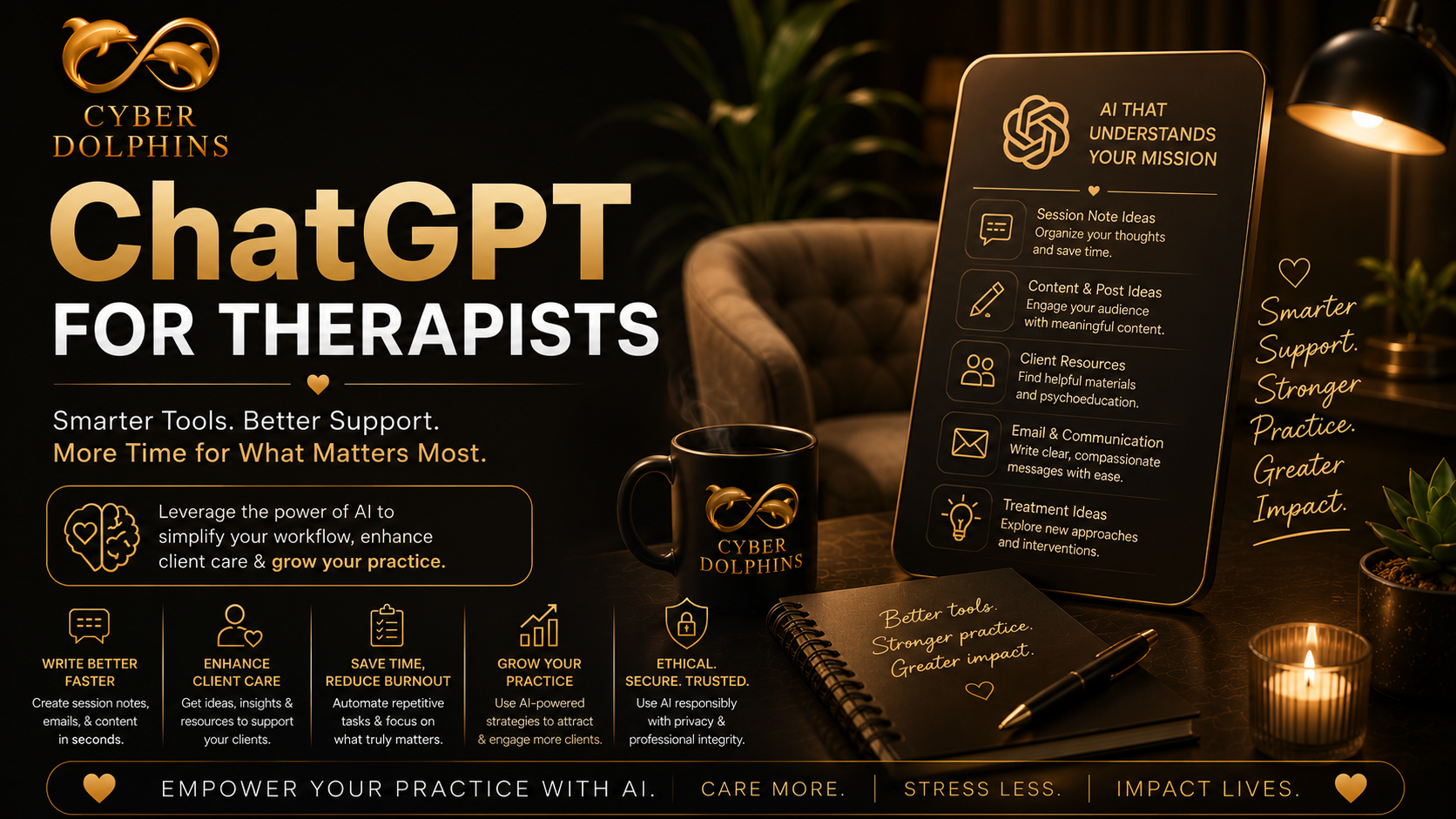
Tools don’t replace voice. They support it.
The question most mental health associates are quietly asking about ChatGPT for therapists is not whether it works. It clearly does. The question is whether using it means compromising something they have spent years building: a professional identity, a clinical voice, a way of communicating about deeply human work that is unmistakably their own.
That concern is legitimate. And it deserves a more honest answer than either the enthusiasts or the sceptics are currently offering.
The enthusiasts say AI saves time and democratises content creation. True, but incomplete. The sceptics say AI produces generic output that cannot capture clinical depth. Also true, but incomplete. The more useful truth is that ChatGPT for therapists is a tool whose value depends entirely on how it is positioned in the content creation workflow. Used as a ghostwriter, it undermines authenticity. Used as a thinking partner, it can actually help therapists find and articulate their voice more consistently than they would unassisted.
The distinction is not semantic. It changes everything about how the tool is used.
The Confidence Gap Problem
Before the question of whether AI compromises authenticity can be answered honestly, a prior problem needs naming: many mental health associates globally are not producing content at all, not because they lack authentic things to say, but because the blank page defeats them.
Clinical training produces practitioners who are skilled at spoken communication, nuanced listening, and real-time therapeutic response. It does not produce writers. The act of translating clinical thinking into written content that is simultaneously accessible, engaging, and professionally credible is a distinct skill that most therapists have never been trained in.
The result is a confidence gap. A therapist who can speak with genuine insight and warmth about anxiety in a session cannot find the same voice on a page. They write two sentences, delete them, start again, and either produce something that sounds nothing like them or produce nothing at all.
ChatGPT for therapists that is used to address this confidence gap, as a scaffold that gets words on the page that the therapist then shapes into their own voice, is not undermining authenticity. It is making authenticity achievable for practitioners who would otherwise not communicate publicly at all.
A mental health marketing agency that understands this dynamic will position AI tools for therapist clients as confidence scaffolds rather than content factories. The output is not the AI’s content. It is the therapist’s thinking, made writable.
Thinking Partner vs Ghostwriter: The Distinction That Matters
Here is the framework that determines whether ChatGPT for therapists supports or undermines authentic content creation.
A ghostwriter produces content on your behalf. You provide a topic or brief. It produces finished or near-finished copy. Your job is to approve or lightly edit. The content carries your name but not your thinking.
A thinking partner is different. You bring your ideas, your observations, your clinical perspective. The thinking partner helps you organise, clarify, and articulate what you already know. The thinking originates with you. The tool helps you get it out of your head and into a form others can read.
Psychology Digital Marketing for mental health associates that uses ChatGPT for therapists in the thinking partner mode produces content that is authentically the practitioner’s because the substance, the specific clinical observations, the particular examples, the individual professional perspective, comes from the practitioner throughout.
The practical difference looks like this.
Ghostwriter mode: “Write me a blog post about anxiety in Indian professionals.”
Thinking partner mode: “I want to write about how high-achieving Indian professionals often mistake anxiety for ambition. Here are three things I observe consistently in my clients: they describe their anxiety as drive, they take pride in it, and they don’t seek help until it stops working for them. Help me organise these observations into a blog post structure.”
The second prompt produces content scaffolded around the therapist’s specific clinical experience. The AI structures and expands. The practitioner’s thinking is the architecture. The result sounds like the practitioner because it is built from the practitioner’s actual observations.
Building a Voice Library Before Engaging AI
One of the most practically useful things mental health professionals can do before using ChatGPT for therapists for content creation is build a personal voice library. This concept has not been addressed in any previous discussion of AI in therapy marketing.
A voice library is a curated collection of the practitioner’s own writing at its most authentic. It can include the best paragraphs from existing blog posts, the language used in welcome emails that clients have responded warmly to, spoken words from a session introduction transcribed and lightly edited, or phrases and framings that feel genuinely like the practitioner’s voice.
This library serves two purposes in an AI-assisted workflow. First, it gives the practitioner a reference point for evaluating AI output. When AI produces a paragraph that sounds plausible but generic, comparing it against the voice library immediately reveals the discrepancy. Second, it can be fed directly into AI prompts to calibrate output toward the practitioner’s actual register.
“Here are three paragraphs from my existing content. This is how I write. Using this as a style guide, help me draft an introduction for a post about…”
Ethical marketing for mental health associates using AI tools starts with this kind of intentional groundwork. It ensures that the AI is serving an existing authentic voice rather than replacing a voice the practitioner never had the chance to develop.
A mental health marketing agency that helps therapist clients build their voice library as a foundational step in any AI-assisted content programme is building toward genuine authenticity rather than the appearance of it.
The Clinical Example Problem
Here is a specific authenticity failure mode in ChatGPT for therapists’ content that Psychology Digital Marketing practitioners working in this space should understand and address.
Clinical examples, the specific, anonymised illustrations of how a presenting concern appears in real therapeutic work, are among the most trust-building elements of therapy content. When a therapist writes “I often work with clients who have never been able to say no at work without feeling as if the relationship is at risk,” that sentence is credible precisely because it is specific. It could only be written by someone who has actually observed this pattern across multiple clients.
AI cannot produce this. It can produce plausible-sounding clinical examples that read as if they come from real experience but do not. These AI-generated examples carry a subtle but perceptible quality of generality. They describe what anxiety, or perfectionism, or relationship difficulty typically looks like according to the training data, not what it actually looks like in the specific clinical experience of the practitioner writing the content.
Experienced therapy clients, referring professionals, and colleagues reading AI-generated clinical examples often notice this quality. They cannot always name it. But the content that was supposed to build trust produces instead a vague sense that something is performed rather than real.
Ethical marketing for mental health professionals using ChatGPT for therapists should establish one non-negotiable rule: clinical examples always come from the practitioner, never from the AI. The AI can help structure, expand, and articulate. The specific clinical observations that make content credible must originate with the human practitioner who actually saw them.
The Editing-to-Authenticity Workflow
For mental health associates who want to use ChatGPT for therapists practically and ethically, the editing-to-authenticity workflow is the most useful operational framework available. It is distinct from both the ghostwriter and the thinking partner models and sits between them in terms of AI involvement.
The workflow has five steps.
Step one: the practitioner writes a rough, unpolished first version. Not edited. Not structured. A brain dump of what they actually want to say. This does not need to be good. It needs to be honest.
Step two: the rough version is given to the AI with instructions to improve structure, readability, and flow without changing the substance, removing specific examples, or altering the tone.
Step three: the AI output is read against the original rough version. Every place where the AI has smoothed out something specific, replaced a concrete example with a generic one, or introduced a phrase that sounds like marketing rather than clinical thinking is identified and restored or rewritten.
Step four: the resulting draft is read aloud. Where it sounds like the practitioner, it stays. Where it sounds like a language model approximating a therapist, it is rewritten.
Step five: the final piece is reviewed against the voice library to confirm it belongs to the same practitioner as the existing body of content.
This workflow uses AI for the tasks it does well, structural improvement, readability, and flow, while keeping the practitioner in control of every substantive, authentic element. Psychology Digital Marketing built on this workflow produces AI-assisted content that is genuinely indistinguishable from unassisted content because the authenticity inputs have remained with the practitioner throughout.
Platform-Specific Authenticity Considerations
ChatGPT for therapists produces different authenticity challenges depending on which platform the content is destined for. Mental health associates who apply the same AI workflow to every content type regardless of platform consistently encounter authenticity failures in specific channels.
LinkedIn content for therapists carries a professional register that AI approximates reasonably well. The formal-but-personal tone that performs on LinkedIn is within AI’s competence when well-prompted, and the editing-to-authenticity process works effectively here.
Instagram content for therapists is more vulnerable to AI authenticity failure. The format rewards brevity, directness, and a quality of conversational intimacy that AI consistently overshoots in the direction of motivational content. AI-generated Instagram captions for therapists tend to sound like wellness coaching rather than clinical practice. The practitioner’s voice is most exposed and most important here.
Long-form blog content sits in the middle. AI can contribute significantly to structure and development. The clinical substance, the specific observations and examples, must come from the practitioner. Ethical marketing principles for this format require that any AI-assisted blog post contain enough genuine practitioner thinking, specific to this practitioner’s actual clinical experience, that the piece could not have been produced by any other therapist with the same brief.
A mental health marketing agency that calibrates AI assistance levels by platform, rather than applying a single workflow across all content types, produces a more authentically varied and platform-appropriate content presence than one treating all channels identically.
When AI-Assisted Content Is Actually More Authentic
Here is an honest observation that the conversation about ChatGPT for therapists and authenticity rarely includes: for some practitioners in some contexts, AI-assisted content is more authentic than unassisted content.
A therapist who struggles to write, who produces stilted, overly formal copy when left alone with a page, but who thinks clearly and speaks with genuine clinical insight when talking about their work, can produce more authentic written content through an AI-assisted workflow than through unaided writing.
The AI-assisted workflow allows the practitioner to bring their actual thinking, through spoken dictation transcribed and given to the AI, through bullet points of genuine clinical observations, through rough conversational language that the AI then renders readable, without the authentic content being lost to the self-consciousness that direct writing often produces.
The practitioner whose authentic voice gets stuck on the page is not less authentic than the practitioner who writes naturally. They simply have a different relationship with written form. ChatGPT for therapists used as a translation layer between authentic clinical thinking and readable written content does not compromise authenticity. It makes it accessible.
Psychology Digital Marketing that acknowledges this reality helps mental health associates use AI tools strategically rather than either avoiding them out of misplaced principle or overusing them out of misplaced efficiency.
The Reader Recognition Problem
Mental health professionals using ChatGPT for therapists should understand one final authenticity consideration that is specific to their client population: therapy clients are often unusually perceptive readers.
People who seek therapy, particularly those who have been in therapy for some time, have developed a heightened sensitivity to authenticity and performance. They are practiced at distinguishing genuine self-disclosure from managed presentation. This is part of what makes therapy work. It is also a specific risk in content marketing for therapists who over-rely on AI.
A client who has developed a sense of their therapist’s voice through sessions, through direct correspondence, through the intake process, and then encounters a blog post that sounds like it was produced by a different mind entirely, will notice. They may not identify AI as the cause. They will simply experience a subtle dissonance between the practitioner they know and the content attributed to that practitioner.
For ethical marketing in a field where the therapeutic relationship is the primary clinical instrument, this dissonance is not a trivial aesthetic concern. It is a trust event. Small ones accumulate.
ChatGPT for therapists used responsibly, as a thinking partner and structural support rather than a voice replacement, produces content that is continuous with the practitioner’s authentic professional identity rather than adjacent to it. That continuity is not just a marketing advantage. It is a clinical one.
The Bottom Line
Mental health associates globally can use ChatGPT for therapists without losing authenticity. But only if the workflow is designed to preserve authenticity as its primary goal rather than treating it as a secondary concern after efficiency.
Tools don’t replace voice. They support it. The thinking partner model, the voice library, the editing-to-authenticity workflow, the non-negotiable rule about clinical examples, and the platform-specific calibration of AI involvement, these are the operational commitments that make the difference between AI-assisted content that sounds like the practitioner and AI-generated content that sounds like a practitioner.
Ethical marketing for therapists is not about using or not using AI tools. It is about using them in a way that keeps the authentic clinical voice of the practitioner at the centre of everything the practice communicates publicly. A mental health marketing agency that builds this discipline into its AI-assisted content services for mental health associates is delivering something the technology alone cannot provide: a framework for remaining genuinely yourself while working efficiently.
Psychology Digital Marketing done this way is not a compromise between authenticity and productivity. It is the only version of AI-assisted therapy content worth producing.
Note: This article is not a diagnostic tool and does not replace professional care.
Ready to grow your practice ethically? We help mental health professionals attract the right-fit clients through a psychology-informed digital strategy. Book Your Discovery Call.