
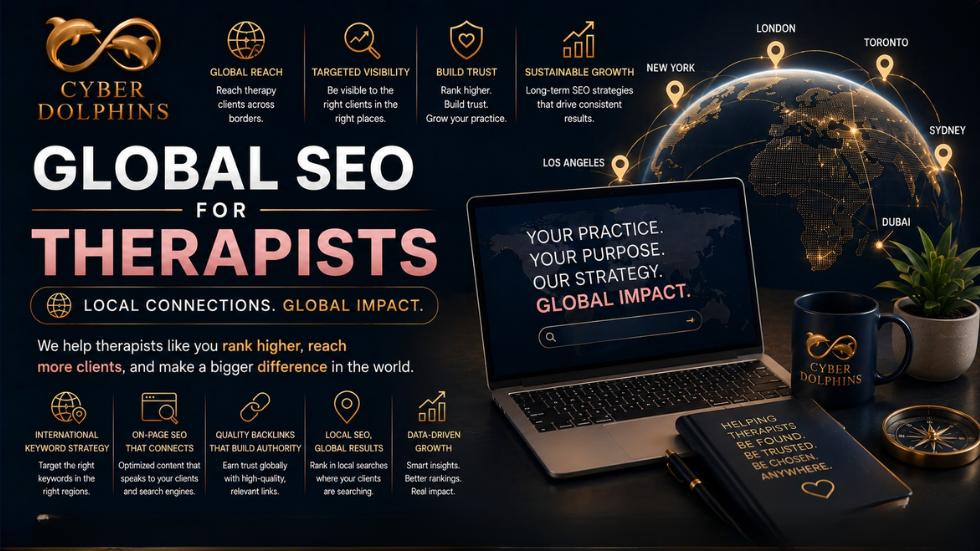
Your clients can be global. Your trust must feel local.
The online therapy market has fundamentally changed what a private practice can look like. A therapist in Amsterdam can build a full caseload serving clients in New York, Toronto, and Singapore. A practitioner in Nairobi can specialise in working with the African diaspora across three continents. Geography is no longer the ceiling it once was.
But global SEO for therapists is not simply local SEO on a larger scale. The mechanics are different. The trust dynamics are different. And the mistakes practitioners make when they attempt to scale visibility internationally, without understanding how search engines handle cross-border content, consistently undermine the very credibility they are trying to build.
A worldwide therapy practice built on solid international SEO foundations grows consistently. One built on the assumption that a single English-language website will rank everywhere it needs to is leaving the majority of its potential market invisible.
How Search Engines Handle International Websites
The foundational concept behind global SEO for therapists is one that most general SEO advice never addresses: search engines serve local results by default.
When someone in Australia searches for an online therapist, Google prioritises results it considers relevant to Australia. When someone in Canada makes the same search, Canadian-relevant results are prioritised. A therapist’s website with no geographic signals beyond its content may rank well in one market and be essentially invisible in another, regardless of quality.
The technical solution is hreflang tags. These are signals added to a website’s code that tell search engines which version of a page is intended for which country and language combination. A worldwide therapy practice serving English-speaking clients in the UK, US, Australia, and Canada needs hreflang implementation that signals to Google: this page is for UK users, this version is for Australian users, here is the canonical source.
Without hreflang, Google makes its own determinations about geographic relevance, and those determinations are often wrong. A Private Practice SEO Agency that works with therapists building international practices will treat hreflang implementation as a foundational requirement, not an optional technical extra.
Domain Strategy: Country Specific vs Subdirectory vs Subdomain
When a worldwide therapy practice is building for multiple markets, the structure of the website itself is a strategic decision with significant SEO consequences.
Three options exist. Country-code top-level domains, such as therapistname.co.uk for the UK and therapistname.com.au for Australia, send the strongest geographic signals to search engines but require maintaining multiple separate websites with separate authority building in each market. This is resource-intensive and usually unnecessary for individual practitioners.
Subdirectories, such as therapistname.com/uk and therapistname.com/australia, consolidate domain authority while still allowing country-specific content and hreflang signals. This is the most practical structure for most global SEO for therapists implementations and is the approach a Private Practice SEO Agency will typically recommend for individual or small group practices building international reach.
Subdomains, such as uk.therapistname.com, sit between these options but carry less consolidated authority than subdirectories and are generally the weakest choice for practitioners building global SEO for therapists from a single practice base.
The right choice depends on practice scale, target markets, and resource capacity. A mental health marketing agency that understands international SEO architecture will map this decision to the specific growth objectives of the practice rather than applying a generic template.
International Keyword Research: Same Intent, Different Language
One of the most consistently overlooked aspects of global SEO for therapists is that the same search intent expresses itself in different languages across different markets.
A client in the United States searching for mental health support is likely to use the word “therapist.” The same client in the United Kingdom is more likely to search for “counsellor.” In Australia, both are common, but “psychologist” carries a different professional weight than in North America. In Canada, French-language searches are significant in Quebec markets.
These are not interchangeable. A worldwide therapy practice whose website uses exclusively American English terminology will rank poorly in British, Australian, and Canadian searches for the same services, because the search terms their potential clients use do not appear in the content.
Online mental health clients in different markets also describe their concerns differently. “Burnout therapist” is a common US search. “Work stress counsellor” is more common in UK markets. “Therapist for relationship issues” dominates in some markets while “couples counsellor” dominates in others.
A mental health marketing agency building global SEO for therapists conducts keyword research market by market, not just once. The content and page optimisation strategy that follows reflects this research rather than assuming one market’s search language maps onto another.
Building Trust Signals Across Jurisdictions
Trust is local even when practice is global. This is the central tension in global SEO for therapists, and the one most practitioners underestimate.
An online mental health client in the UK, evaluating a therapist based in another country, is asking a set of trust questions specific to their context. Are you registered with a professional body I recognise? Do you hold liability insurance that covers international clients? Are you familiar with the mental health frameworks and cultural references that are part of my daily life?
A worldwide therapy practice that addresses these questions explicitly in its marketing, by jurisdiction, consistently converts international visitors at a higher rate than one presenting a single, undifferentiated professional identity.
This might mean a dedicated page for UK clients that mentions BACP or UKCP registration equivalence, the therapist’s familiarity with NHS waiting list context, and explicit confirmation that professional insurance covers UK-based clients. A separate page for Canadian clients addresses a different regulatory context and cultural references. Each page is optimised for country-specific search terms and structured to answer the trust questions specific to that market.
This is not duplication. It is precision. A Private Practice SEO Agency that understands international practice development will build this jurisdiction-specific trust architecture as a core component of the SEO strategy.
Regulatory Compliance as a Trust Signal
Here is a dimension of global SEO for therapists that no previous blog has addressed: the way a practice handles international data privacy regulations is itself a marketing signal.
GDPR compliance is legally mandatory for any therapist working with clients based in the European Union or UK, regardless of where the therapist is located. But beyond legal compliance, explicit GDPR acknowledgement on a website communicates something important to a European online mental health client: this practitioner has thought carefully about my rights and my data.
A privacy policy that clearly explains how session notes are stored, who has access to them, how long they are retained, and what rights the client has under applicable law is not just a legal requirement. For a client choosing to share deeply personal information with a therapist across international borders, it is a meaningful trust signal.
Global SEO for therapists that incorporates compliance transparency, GDPR for European clients, HIPAA awareness for US clients, PIPEDA for Canadian clients, into the website architecture builds credibility with a sophisticated, research-oriented international client base that a generic “your privacy is important to us” statement does not.
A mental health marketing agency working with international practices should include compliance communication as part of their content strategy, not as a legal afterthought.

Cross-Border Social Proof
Social proof for a worldwide therapy practice requires a different approach than for a domestic practice.
A UK client reading a testimonial from a US client does not automatically transfer that trust. The cultural context, the therapeutic landscape, and the specific concerns that the client brought to therapy may feel distant. Cross-border social proof works best when it is specific about the client’s country of origin and the particular experience of accessing therapy internationally.
An anonymised case description that reads “a client in Canada navigating the transition from in-person to online therapy after relocating from the UK” speaks directly to an international client’s specific situation. It demonstrates that the practice has successfully worked across exactly the geographic and logistical complexity the prospective client is managing.
Online mental health clients choosing a therapist outside their home country have a higher threshold for social proof because the decision carries more uncertainty. Global SEO for therapists that incorporates jurisdiction-specific and experience-specific social proof, across website copy, directory profiles, and content, consistently converts this audience more effectively than generic testimonials.
Platform Differences by Region
The directory and platform landscape for online mental health clients varies significantly by region, and a worldwide therapy practice that lists only on platforms dominant in one market is invisible to clients searching from others.
Psychology Today is dominant in North America but has limited penetration in the UK, where Counselling Directory and BACP’s therapist finder are primary search resources. In Australia, the Australian Psychological Society’s Find a Psychologist directory carries significant authority. In Germany, Jameda is a major healthcare professional platform. In India, Practo and similar platforms dominate local search.
Global SEO for therapists includes a deliberate platform strategy mapped to the specific markets the practice is targeting. Maintaining complete, keyword-rich profiles on the dominant directory in each target market is one of the highest-leverage visibility actions available to a worldwide therapy practice because these directories carry existing domain authority in their respective markets that a new practice website cannot replicate quickly.
A Private Practice SEO Agency building international visibility will identify the authoritative directories in each target market and treat profile optimisation on those platforms as a core component of the strategy, not a secondary consideration.
Booking and Payment Friction Across Borders
A worldwide therapy practice can rank globally and convert poorly because of a single overlooked obstacle: a booking and payment infrastructure that creates friction for international clients.
A client in Singapore attempting to book a session with a therapist based in Europe who only accepts bank transfers to a European account faces an immediate practical barrier. A client in Canada, being asked to pay in Euros without a currency conversion explanation, faces uncertainty that may convert into abandonment.
Online mental health clients choosing international practitioners are already navigating more uncertainty than clients booking locally. Every additional logistical friction point increases the probability they will find a local alternative instead.
Global SEO for therapists that drives international traffic to a practice without addressing payment accessibility, currency transparency, booking system compatibility across time zones, and session format confirmation for international clients is generating traffic it cannot convert.
A mental health marketing agency building a strategy for a worldwide therapy practice should treat the international client booking experience as a conversion optimisation problem with the same seriousness as keyword strategy or content development.
The Bottom Line
Global SEO for therapists is a distinct discipline from local SEO, and treating it as simply a scaled-up version of domestic practice marketing consistently underdelivers.
Your clients can be global. Your trust must feel local. That means hreflang architecture that signals geographic relevance correctly. International keyword research that reflects how different markets describe the same need. Jurisdiction-specific trust signals that answer the questions your international clients are actually asking. Compliance transparency that demonstrates you have thought about their rights across borders. Platform presence in the directories that serve each target market.
A Private Practice SEO Agency or mental health marketing agency that understands international therapy practice will build this architecture deliberately, market by market, because online mental health clients choosing a therapist across borders have a higher trust threshold, not a lower one.
A worldwide therapy practice built on these foundations does not just rank globally. It converts globally, because every international client who finds you already finds evidence that you were thinking about them specifically.
Note: This article is not a diagnostic tool and does not replace professional care.
Ready to grow your practice ethically? We help mental health professionals attract the right-fit clients through a psychology-informed digital strategy. Book Your Discovery Call.